

Improving Comprehension & Navigation of Smart Thermostat
I led the redesign of Vivint's app and panel
thermostat experience to support the broader strategy of modernizing to better support new energy features, including demand response.
2025 | Lead Product Designer

Improving Comprehension & Navigation of Smart Thermostat
I led the redesign of Vivint's app and panel
thermostat experience to support the broader strategy of modernizing to better support new energy features, including demand response.
2025 | Lead Product Designer

Improving Comprehension & Navigation of Smart Thermostat
I led the redesign of Vivint's app and panel thermostat experience to support the broader strategy of modernizing to better support new energy features, including demand response.
2025 | Lead Product Designer
Challenge
Challenge
Challenge
After NRG acquired Vivint, the organization set out to dramatically scale thermostat adoption to support grid-level demand response. This created two parallel initiatives:
A short-term effort to reuse existing hardware with new software (Codename: Titan)
A long-term effort to design a best-in-class thermostat that preserved Vivint’s premium brand and competed at the top of the market (Codename: Pegasus)
This case study focuses on Titan.
Users needed a thermostat that made sense no matter the touchpoint & allowed them to access the information and features they needed for a comfortable home.
After NRG acquired Vivint, the organization set out to dramatically scale thermostat adoption to support grid-level demand response. This created two parallel initiatives:
A short-term effort to reuse existing hardware with new software (Codename: Titan)
A long-term effort to design a best-in-class thermostat that preserved Vivint’s premium brand and competed at the top of the market (Codename: Pegasus)
This case study focuses on Titan.
Users needed a thermostat that made sense no matter the touchpoint & allowed them to access the information and features they needed for a comfortable home.
After NRG acquired Vivint, the organization set out to dramatically scale thermostat adoption to support grid-level demand response. This created two parallel initiatives:
A short-term effort to reuse existing hardware with new software (Codename: Titan)
A long-term effort to design a best-in-class thermostat that preserved Vivint’s premium brand and competed at the top of the market (Codename: Pegasus)
This case study focuses on Titan.
Users needed a thermostat that made sense no matter the touchpoint & allowed them to access the information and features they needed for a comfortable home.
Design Solution
Design Solution
Design Solution
Rather than redesigning the app in isolation, I focused on unifying the entire thermostat experience around a single mental model.
The redesign centered on 4 principles:
Rather than redesigning the app in isolation, I focused on unifying the entire thermostat experience around a single mental model.
The redesign centered on 4 principles:
Rather than redesigning the app in isolation, I focused on unifying the entire thermostat experience around a single mental model.
The redesign centered on 4 principles:
One thermostat, one mental model
One thermostat, one mental model
One thermostat, one mental model
Recognition over recall
Recognition over recall
Recognition over recall
Visibility of system status
Visibility of system status
Visibility of system status
Strong affordance
Strong affordance
Strong affordance

Impact
Impact
Impact
Users now navigate between thermostats dramatically faster and recognize system status intuitively
85% → 100% task success when switching thermostats
9 sec → 3 sec average time to switch between thermostats
14x improvement in spontaneous recognition of HVAC system status (5% → 72%)
Users now navigate between thermostats dramatically faster and recognize system status intuitively
85% → 100% task success when switching thermostats
9 sec → 3 sec average time to switch between thermostats
14x improvement in spontaneous recognition of HVAC system status (5% → 72%)
Users now navigate between thermostats dramatically faster and recognize system status intuitively
85% → 100% task success when switching thermostats
9 sec → 3 sec average time to switch between thermostats
14x improvement in spontaneous recognition of HVAC system status (5% → 72%)
By making the interaction model of the app match the hardware and replacing the hidden entrypoint to view additional thermostats with a landing dashboard showing all thermostats in the home, users immediately understood how to interact, where they were, and where they wanted to go.
By making the interaction model of the app match the hardware and replacing the hidden entrypoint to view additional thermostats with a landing dashboard showing all thermostats in the home, users immediately understood how to interact, where they were, and where they wanted to go.
By making the interaction model of the app match the hardware and replacing the hidden entrypoint to view additional thermostats with a landing dashboard showing all thermostats in the home, users immediately understood how to interact, where they were, and where they wanted to go.
Process
Process
Foundational Research
Foundational Research
Foundational Research
Design Exploration
Design Exploration
Design Exploration
Usability Testing
Usability Testing
Usability Testing
Design Refinement
Design Refinement
Design Refinement
Development
Development
Development
Foundational Research Insights
Foundational Research Insights
Foundational Research Insights
I partnered with our research team to conduct foundational research to understand how users perceive and interact with thermostats in their homes. These insights informed my design principles.
I partnered with our research team to conduct foundational research to understand how users perceive and interact with thermostats in their homes. These insights informed my design principles.
I partnered with our research team to conduct foundational research to understand how users perceive and interact with thermostats in their homes. These insights informed my design principles.
Controlling the same thermostat felt different depending on where the user interacted with it
Controlling the same thermostat felt different depending on where the user interacted with it
Controlling the same thermostat felt different depending on where the user interacted with it
The physical thermostat had been carefully designed around straightforward directional interactions. The app, meanwhile, borrowed visual and interaction patterns from another brand entirely. That inconsistency increased cognitive effort every time someone moved between the wall and the app.
The physical thermostat had been carefully designed around straightforward directional interactions. The app, meanwhile, borrowed visual and interaction patterns from another brand entirely. That inconsistency increased cognitive effort every time someone moved between the wall and the app.
The physical thermostat had been carefully designed around straightforward directional interactions. The app, meanwhile, borrowed visual and interaction patterns from another brand entirely. That inconsistency increased cognitive effort every time someone moved between the wall and the app.
Schedule feature is hidden in settings
Clarity of UI & architecture
Clarity of UI & architecture
Customers purchased smart thermostats expecting to automate their home comfort with schedules. However, many users assumed Vivint simply did not support schedules because they never discovered it in settings.
Customers purchased smart thermostats expecting to automate their home comfort with schedules. However, many users assumed Vivint simply did not support schedules because they never discovered it in settings.
Customers purchased smart thermostats expecting to automate their home comfort with schedules. However, many users assumed Vivint simply did not support schedules because they never discovered it in settings.
Full screen color takeover is valuable
Situationally responsive info
Situationally responsive info
Participants appreciated the ability to immediatley recognize the status of their HVAC from the color of their thermostat tab background.
Participants appreciated the ability to immediatley recognize the status of their HVAC from the color of their thermostat tab background.
Participants appreciated the ability to immediatley recognize the status of their HVAC from the color of their thermostat tab background.
Design Exploration
Design Exploration
Design Exploration
Design exploration was informed by foundational research and refined through multiple design reviews.
Design exploration was informed by foundational research and refined through multiple design reviews.
Design exploration was informed by foundational research and refined through multiple design reviews.


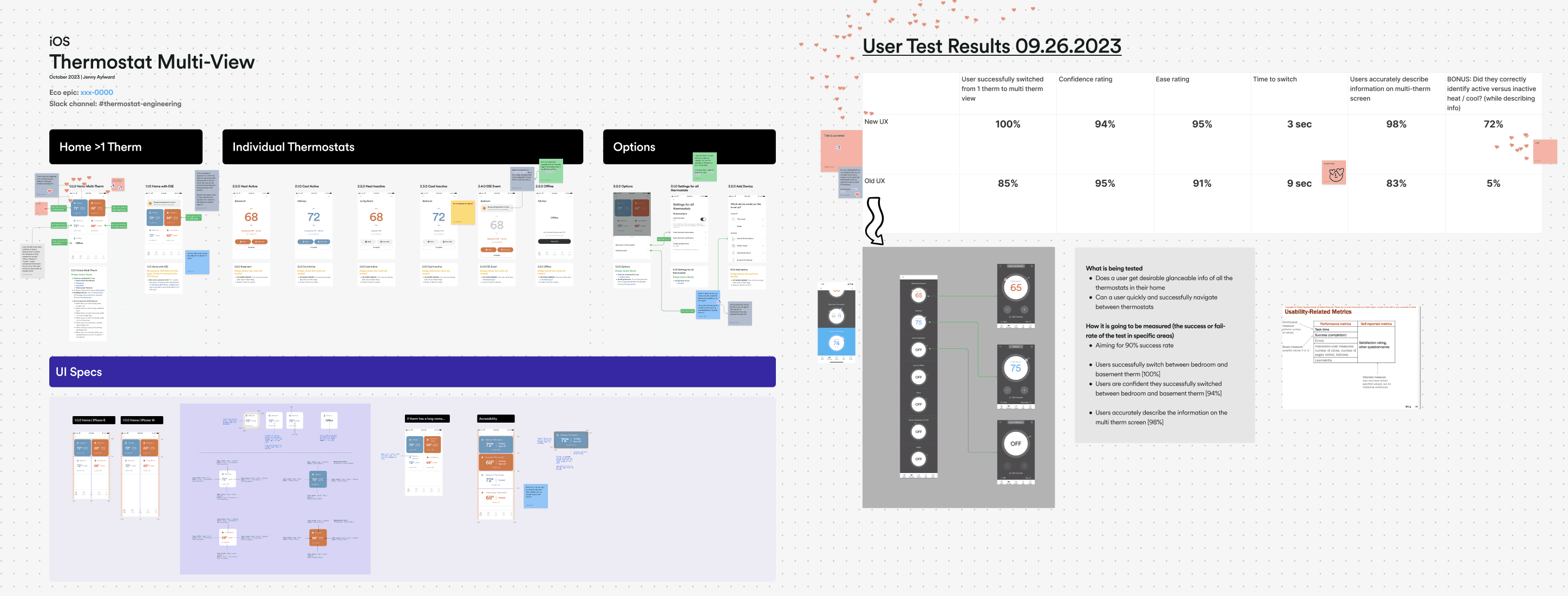


Weekly design reviews with the Vivint Innovation Design Team. A breadth of options were explored before settling on the final design.
Weekly design reviews with the Vivint Innovation Design Team. A breadth of options were explored before settling on the final design.
Usability Testing
Usability Testing
Usability Testing
To validate whether the redesign improved usability rather than just modernizing the visual design, I worked with a research partner to run a comparative usability study of the legacy thermostat app experience and the redesign.
To validate whether the redesign improved usability rather than just modernizing the visual design, I worked with a research partner to run a comparative usability study of the legacy thermostat app experience and the redesign.
To validate whether the redesign improved usability rather than just modernizing the visual design, I worked with a research partner to run a comparative usability study of the legacy thermostat app experience and the redesign.
New UX
New UX
New UX

Legacy UX
Legacy UX
Legacy UX

Methodology
Methodology
Methodology
30 participants completed the same core tasks in both versions, including switching between thermostats and interpreting HVAC status. To reduce order bias, the experience order was randomized.
30 participants completed the same core tasks in both versions, including switching between thermostats and interpreting HVAC status. To reduce order bias, the experience order was randomized.
Participants were asked to attempt the same 7 core tasks on each thermostat.
The study measured
The study measured
The study measured
Task success
Time on task
Ease of use
Comprehension of thermostat mode and HVAC activity
Ability to locate the Schedule and additional thermostats
Task success
Time on task
Ease of use
Comprehension of thermostat mode and HVAC activity
Ability to locate the Schedule and additional thermostats
Task success
Time on task
Ease of use
Comprehension of thermostat mode and HVAC activity
Ability to locate the Schedule and additional thermostats
For comprehension, participants were not directly asked about thermostat activity. Instead, they were asked to describe what they were seeing on each screen. Responses were then coded for whether participants spontaneously and correctly identified thermostats mode and activity. This approach measured whether the interface itself offered intuitive system status, rather than whether users could answer a leading question.
For comprehension, participants were not directly asked about thermostat activity. Instead, they were asked to describe what they were seeing on each screen. Responses were then coded for whether participants spontaneously and correctly identified thermostats mode and activity. This approach measured whether the interface itself offered intuitive system status, rather than whether users could answer a leading question.
To reduce learning effects and bias
To reduce learning effects and bias
To reduce learning effects and bias
Task order was randomized per participant
Experience testing order was randomized per participant
Task order was randomized per participant
Experience testing order was randomized per participant
Task order was randomized per participant
Experience testing order was randomized per participant
This structure allowed us to measure performance, expectation versus reality, comprehension, and perceived usability.
This structure allowed us to measure performance, expectation versus reality, comprehension, and perceived usability.
This structure allowed us to measure performance, expectation versus reality, comprehension, and perceived usability.
Results
Results
Results
In the legacy expirience, only 5% of participants naturally described the correct mode and HVAC activity. In the new experience, 72% naturally described the correct mode and HVAC activity.
In the legacy expirience, only 5% of participants naturally described the correct mode and HVAC activity. In the new experience, 72% naturally described the correct mode and HVAC activity.
In the legacy expirience, only 5% of participants naturally described the correct mode and HVAC activity. In the new experience, 72% naturally described the correct mode and HVAC activity.
In the legacy expirience, only 85% of participants successfully found another thermostat, in an average of 9 seconds. In the new experience, 100% of participants successfully navigated between thermostats, in an average of 3 seconds.
In the legacy expirience, only 85% of participants successfully found another thermostat, in an average of 9 seconds. In the new experience, 100% of participants successfully navigated between thermostats, in an average of 3 seconds.
In the legacy expirience, only 85% of participants successfully found another thermostat, in an average of 9 seconds. In the new experience, 100% of participants successfully navigated between thermostats, in an average of 3 seconds.


Design Refinement
Design Refinement
Design Refinement
Colors were refined with new brand colors. Spacing was refined on the controls screens. Hierarchy and layout of cards were refined, as well as updated language "cooled to 65º" became "currently 65º" for clarity. A large size card was introduced for accessibility and preference.
Colors were refined with new brand colors. Spacing was refined on the controls screens. Hierarchy and layout of cards were refined, as well as updated language "cooled to 65º" became "currently 65º" for clarity. A large size card was introduced for accessibility and preference.
Colors were refined with new brand colors. Spacing was refined on the controls screens. Hierarchy and layout of cards were refined, as well as updated language "cooled to 65º" became "currently 65º" for clarity. A large size card was introduced for accessibility and preference.


Why this works
Why this works
Why this works
Unified interaction model from device to hub to app
Unified interaction model from device to hub to app
Unified interaction model from device to hub to app
Clear system status
Clear system status
Clear system status
Users can find the Schedule feature
Users can find the Schedule feature
Users can find the Schedule feature
High affordance for navigation and feature discovery
High affordance for navigation and feature discovery
High affordance for navigation and feature discovery
Release schedule
Release schedule
Release schedule
Alpha: April 2025
Alpha: April 2025
Alpha: April 2025
Beta: May 2025
Beta: May 2025
Beta: May 2025
General availability: June 2025
General availability: June 2025
General availability: June 2025
View more work
View more work
View more work

Thermostat Installation
Reducing risk of errors and damage costs through guided UX and automation.
View Project
Jenny Eckles 2026
Jenny Eckles 2026